Book Details
Transform Data into Intelligence at Cloud Scale.
Key Features ● Get a free one-month digital subscription to www.avaskillshelf.com. ● Production-grade BigQuery warehouse engineering covering data modeling, partitioning, clustering, and cost optimization. ● End-to-end pipeline engineering with dbt, Apache Beam, Dataflow, Cloud Composer, and CI/CD automation. ● Two complete capstone projects — a real-time streaming analytics system, and a full dbt as well as BigQuery ELT platform.
Book Description
Every Great AI System Begins with a Great Data Platform
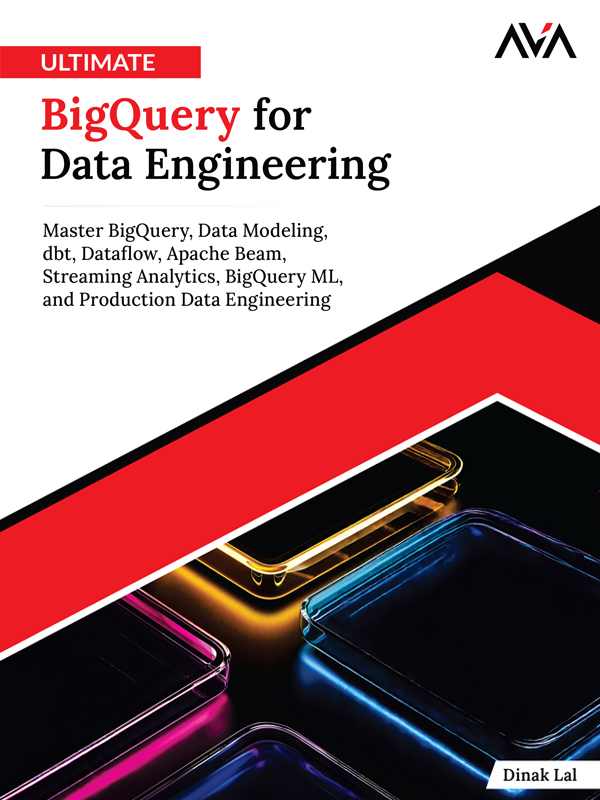
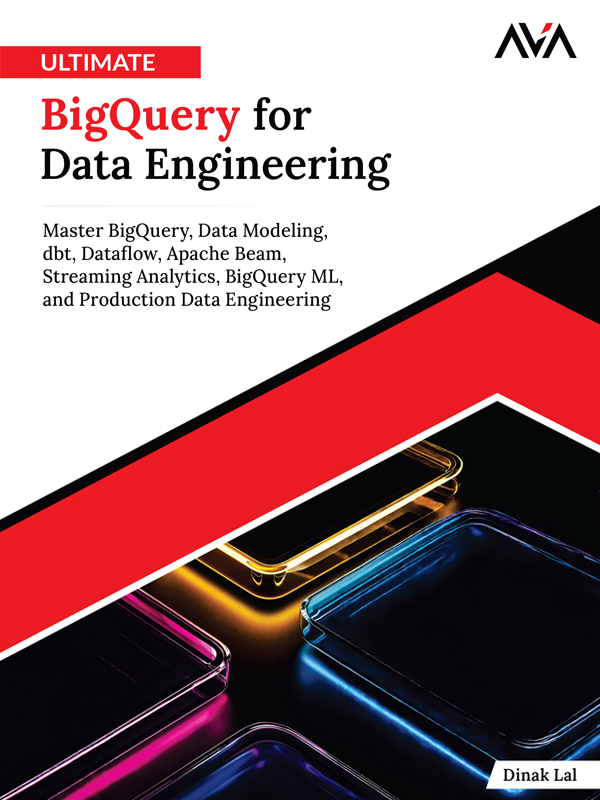
BigQuery is the backbone of modern cloud data engineering. Ultimate BigQuery for Data Engineering takes you from SQL fundamentals to building a complete production analytics platform on Google Cloud — with hands-on labs and real engineering patterns at every stage.
You begin with BigQuery internals — columnar storage, Dremel execution, and slot management — then advance through data modeling, partitioning, clustering, cost engineering, and ELT pipelines with dbt. The book covers Apache Beam, Dataflow, Cloud Composer, and streaming analytics with Pub/Sub, before addressing enterprise governance, including row-level security, column masking, data quality testing, CI/CD automation, and ML with BigQuery ML as well as Vertex AI.
The final three chapters deliver two complete capstone projects — a real-time streaming analytics system and a full warehouse ELT platform built with dbt and BigQuery — before closing with the future of BigQuery and emerging trends that will shape the next generation of cloud data engineering. Thus, by the end, you will have a portfolio of production-grade projects that prove your skills on Google Cloud!
What you will learn ● Master BigQuery internals including columnar storage, Dremel execution, and slot management. ● Design scalable data models using partitioning, clustering, and physical optimization strategies. ● Build production-grade ELT pipelines using dbt transformation layers and automated CI/CD workflows. ● Implement streaming analytics using Apache Beam, Dataflow, Pub/Sub, and Cloud Composer orchestration. ● Secure data warehouses using row-level security policies, column masking, and data quality testing. ● Deploy ML models and predictions using BigQuery ML and Vertex AI on Google Cloud.
Table of Contents 1. Data Engineering Basics and BigQuery's Role 2. Inside BigQuery Storage, Compute, and Execution 3. Getting Data into BigQuery 4. Modeling for Scale 5. Partitioning, Clustering, and Optimization 6. Performance and Cost Engineering 7. ELT with dbt and BigQuery 8. Apache Beam and Dataflow 9. Spark and BigQuery Integration 10. Security, Governance, and Data Quality 11. BigQuery ML and Vertex AI 12. Real-Time Streaming Analytics 13. Enterprise Warehouse and ELT Project 14. The Future of BigQuery and Emerging Trends Index
About the Author Dinak Lal is a data engineer specializing in cloud-native data platforms. With extensive experience building production BigQuery warehouses, dbt pipelines, and streaming analytics systems, he helps organizations transform raw data into insights. Dinak bridges the gap between SQL-focused analysts and infrastructure engineers.
Author Description
Dinak Lal is a data engineer specializing in cloud-native data platforms. With extensive experience building production BigQuery warehouses, dbt pipelines, and streaming analytics systems, he helps organizations transform raw data into insights. Dinak bridges the gap between SQL-focused analysts and infrastructure engineers.
Read this book in our EasyReadz App for Mobile or Tablet devices
To read this book on Windows or Mac based desktops or laptops:


 Your cart is empty
 Sneak Preview